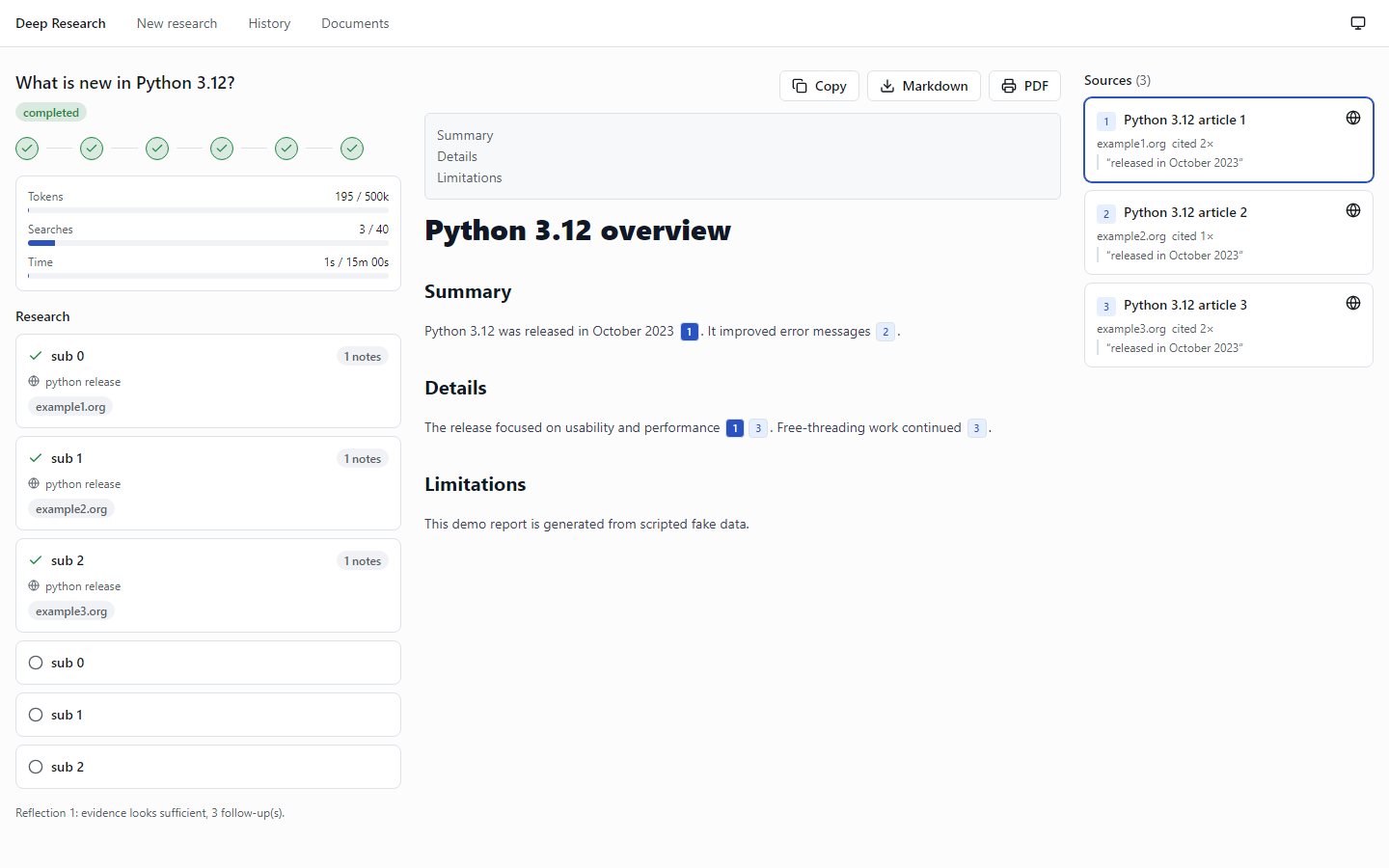
Status, stated plainly: built, tested (pytest, vitest, Playwright) and runs locally. The eval suite is built, but its live results have not been published yet, so this page makes no quality claims.
The problem
“Research agents” are easy to build and hard to trust. They cite sources that don’t say what the sentence claims, they follow instructions hidden in web pages, and they run up cost with no ceiling. I wanted a report where every citation can be checked and the system says what it could not support.
Constraints
- A citation must point at text that actually supports the sentence. Not just a URL from the same search.
- Web content is untrusted input. Pages can contain instructions aimed at the model.
- Bounded cost and time, visible to the user while the run is going.
- Long runs must survive failures: a crash, a closed tab, a cancel.
What I built
-
clarify -
plan -
approve plan -
research_worker ×N -
collect -
reflect (loop on gaps) -
write -
verify -
finalize
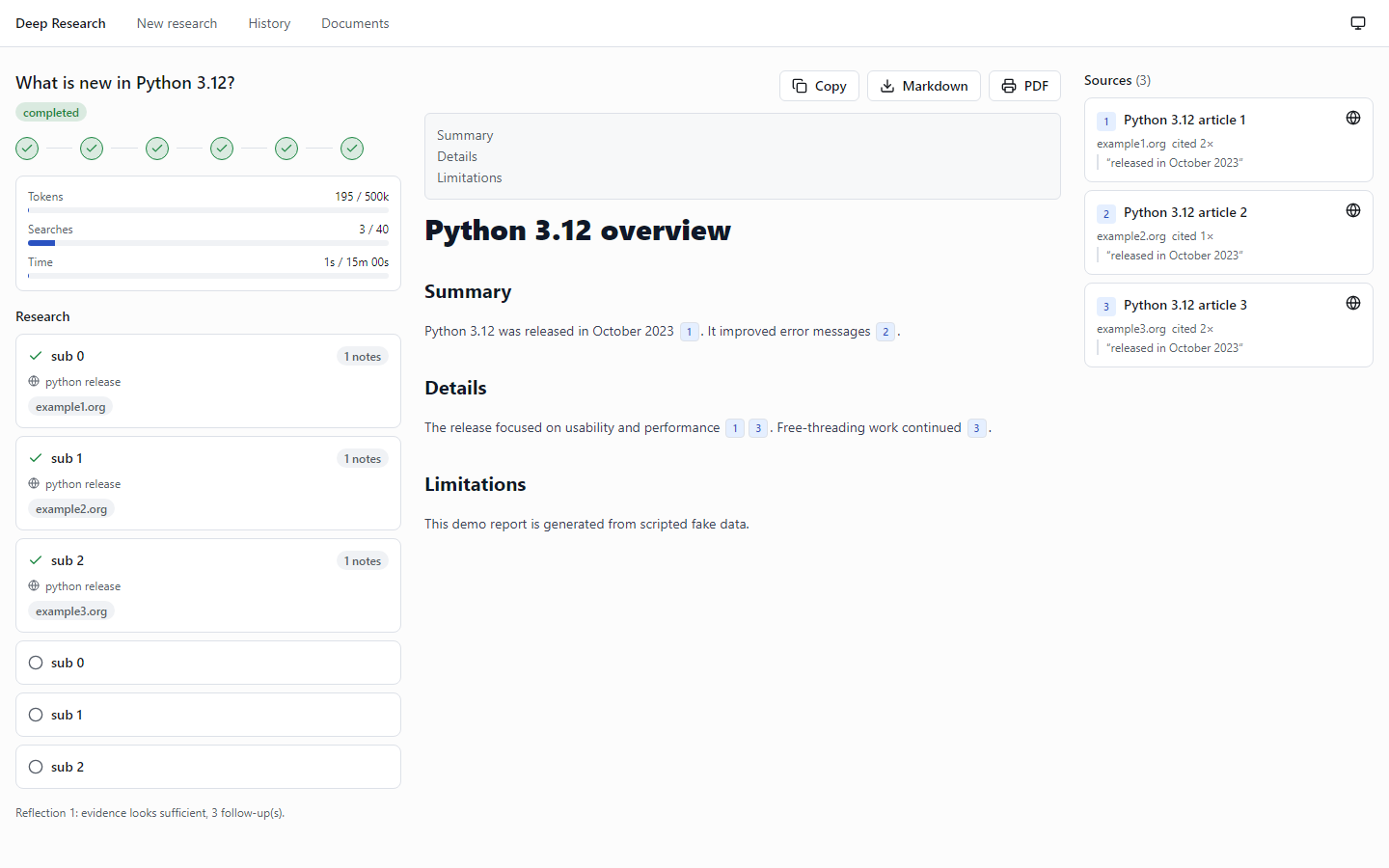
1. Two layers of grounding. Workers must return claim + verbatim snippet + source ID, and code drops any note whose snippet isn’t literally in the stored source. The verifier then judges each written sentence against its cited notes.
2. Defending against hostile content. Retrieved text is wrapped in delimiters and sanitised (hidden characters, instruction-like sentences, delimiter spoofing). Each finding is emitted as a warning event. Tools are read-only, and unsafe URLs (private IPs, non-http) are blocked.
3. Events as the source of truth. Every run emits typed, sequenced events that are persisted. A dropped connection resumes from the last event, a finished run replays exactly, and history comes for free.
How it will be measured
19 questions: 7 web (some time-sensitive), 5 documents-only against a fixture corpus, 5 mixed, and 2 adversarial (a page with an injection, and an unanswerable question). Scoring uses an LLM rubric judge (coverage, accuracy, calibration), plus an automated citation-validity check. Targets: average coverage ≥ 4/5, citation validity ≥ 95%, zero injection compliance.
TODO: run the live eval, commit the report, and publish the table here: coverage, citation validity, injection compliance, cost per run, p50 time. Add a verifier-on vs verifier-off comparison. That comparison is this project’s strongest possible result.
Known limitations
- Single-user and local: no auth and no cloud deployment yet.
- The LLM judge shares a model family with the writer; a spot-check by hand is still needed.
What I’d do next
- Publish eval results, including the verifier ablation.
- Deploy the offline
demomode publicly, so anyone can click through without keys, and gate live runs. - Add per-run cost to the exported report so a reader can see what a brief cost.