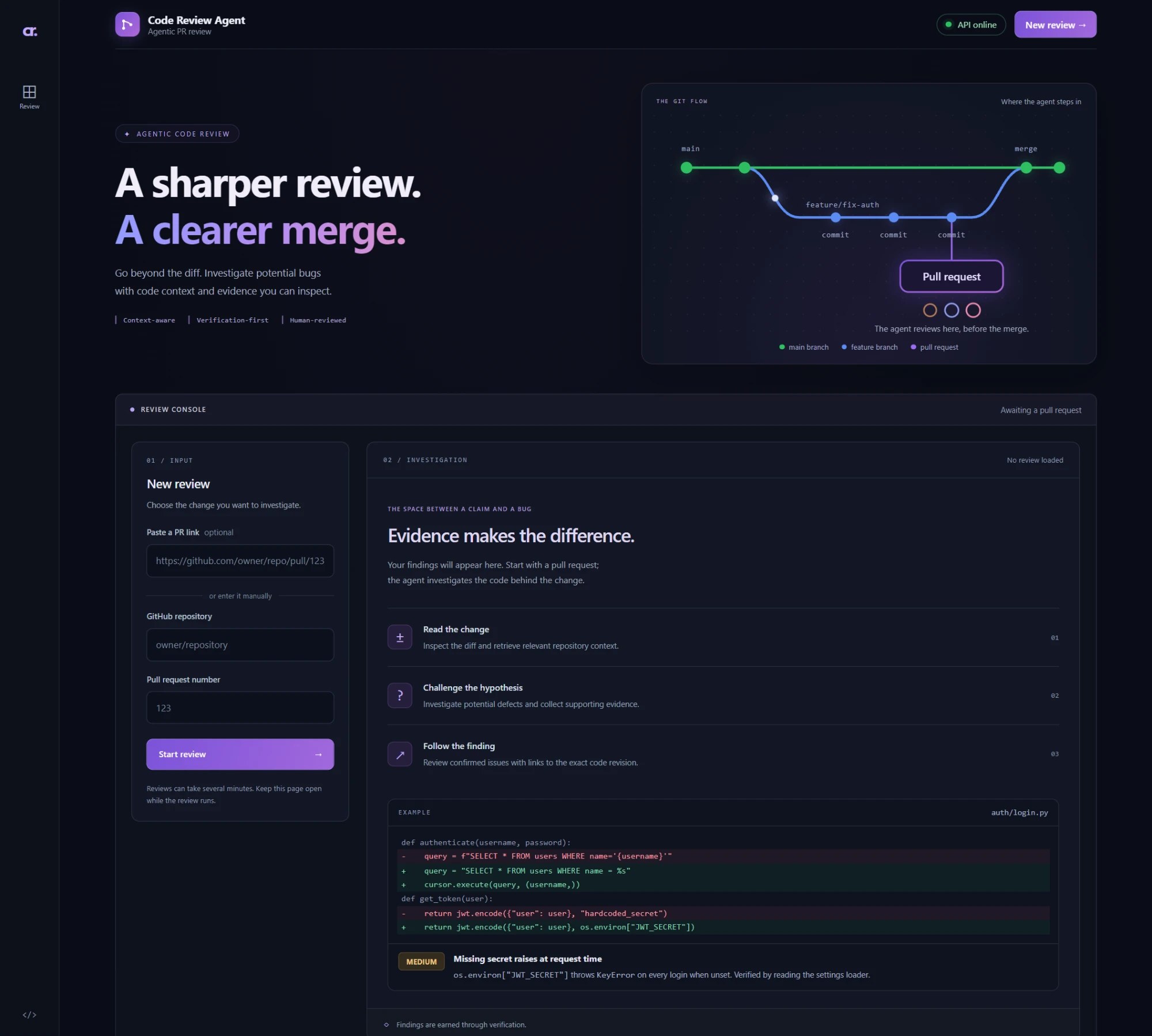
The short version: every architecture, including the cheap diff-only baseline, scored 95–100% on my test set. The benchmark is saturated, so it can’t yet show whether the multi-agent design is worth its 8x cost. Building a harder test set is the next job.
The problem
Reviewers that only read the diff flag code that looks wrong in isolation but is fine in context: a caller that already guards the input, a config value, an existing test. Every false alarm costs reviewer attention, and teams soon learn to ignore the bot.
Constraints
- Precision matters more than coverage. A reviewer that cries wolf gets switched off.
- Claims must be checkable. A finding is useful only if a developer can follow its evidence in seconds.
- Bounded cost. Agent loops must not run up unbounded tool calls or tokens on a large PR.
- Running untrusted code is dangerous. Any test execution needs isolation, with no network access.
What I built
-
fetch_pr -
analyse_diff -
load_repo_tree -
retrieve_context -
supervisor -
specialists ×3 (parallel) -
evidence_judge -
merge_findings -
generate_review
1. Hypothesis → evidence → verdict. Specialists don’t write findings directly. They propose hypotheses, gather evidence with tools, and a single shared judge confirms or discards each one. That gives every specialist the same standard of proof.
2. Revision pinning. All inspection and every link uses the PR’s exact commit SHA, so the evidence a reviewer clicks on is the code that was reviewed.
3. Hard budgets. 3 model turns and 6 tool calls per hypothesis, a maximum of 5 hypotheses per specialist, and 30 tool calls per review, shared across specialists.
4. Execution as optional evidence. pytest and Ruff run in locked-down, network-less Docker containers, on a separate worker so the API host never executes PR code.
Result
Live run on 23 Nov 2026, model gpt-6-luna, one run per mode at default temperature. The test set has 30 synthetic Python PRs: 20 with one planted bug each (concrete trigger and consequence), and 10 clean. Two of the buggy cases need caller or config context to judge.
| Mode | What it does | Bug recall | False findings (10 clean PRs) | Tool calls / review | p50 / p95 latency | Cost / review |
|---|---|---|---|---|---|---|
diff_only | Structured review of the diff alone (baseline) | 95% (19/20) | 0 | 0 | 3.7 s / 4.8 s | $0.00011 |
context | Context retrieval, then a structured review | 100% (20/20) | 0 | 1.7 | 7.6 s / 9.1 s | $0.00021 |
verification | Full multi-agent hypothesis and evidence graph | 100% (20/20) | 0 | 3.2 | 20.8 s / 27.0 s | $0.00085 |
All 90 reviews completed. The whole run cost about $0.035. Each finding was matched to the planted bug by meaning (same trigger and consequence), not by line number. Every finding matched its bug, and no PR got a duplicate or extra finding.
What this does and doesn’t show
- The only case that separated the architectures was
caller-contract. A lookup now returnsNone, and the crash only happens in a caller in another file. Diff-only missed it; both context-aware modes caught it. - The other context case,
shared-constant, was caught even by diff-only, because the variable names gave the units away. - The full verification graph costs about 8x diff-only and 4x context, and is about 3x slower than context. On this test set it bought nothing extra. That is not evidence that verification is useless. It is evidence that these single-function bugs are too easy to need it.
- Zero false findings across 30 clean-PR reviews is the encouraging part: none of the modes cried wolf on renames, docstrings, equivalent rewrites or formatting.
Known limitations
- The test set is small, synthetic, Python-only and saturated: 59 of 60 possible bug detections were made. It cannot rank the architectures.
- One run per mode at default temperature, so run-to-run variance is not measured yet.
- The eval measures inspection-based verification. Sandbox execution is excluded from it.
- Before drawing production conclusions, the test set needs pinned, independently adjudicated real PRs, more languages and larger repositories.
What I’d do next
- Build a harder test set where the diff alone is misleading: cross-file contracts, config-dependent behaviour, and plausible-looking changes that are actually fine. Then re-run all 3 modes, 3 times each.
- Add 10 real, already-merged open-source PRs with known follow-up fixes.
- Publish one public LangSmith trace of a full verification review.
- Write a 2-week pilot plan for one team’s repos: success means comments that get accepted, not more comments.
How it was built
Built with heavy use of Claude Code as a pair programmer. State what you designed and verified yourself (e.g. the hypothesis/judge architecture, budgets, eval design and adjudication rules) and make sure you can whiteboard the graph and debug any node live.
TODO: the multi-agent version lives on branch feat/multi-agent-specialists. Merge it into the default branch before linking the repo publicly, so reviewers see the version described here.